Merit Meets Capital
Vol. XXIII

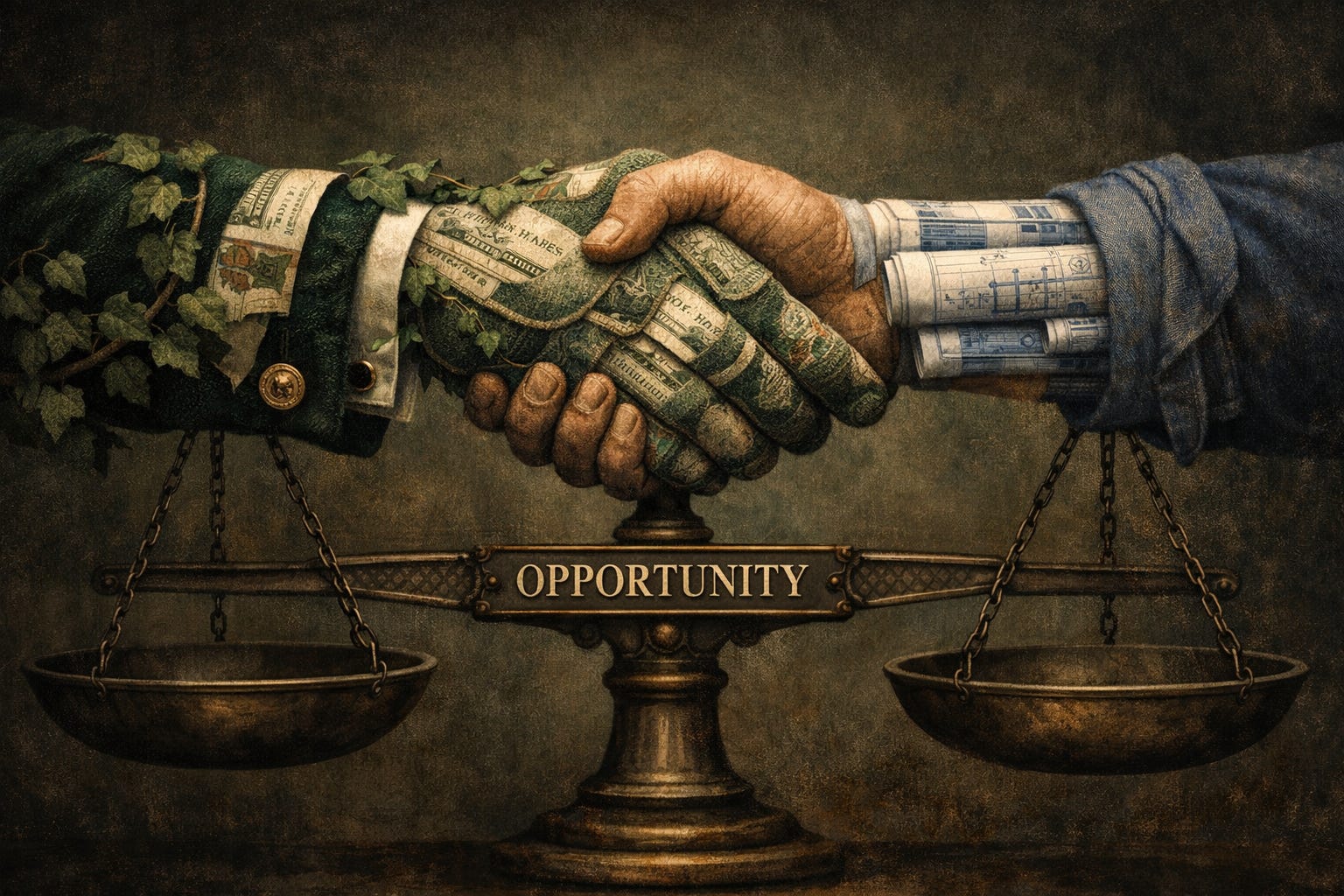
A friend of mine once described the Ivy League’s purpose in five words: “it pairs capital with labor.” I laughed when he said it, partly because it sounded cynical and partly because I couldn't think of a single good reason he was wrong.
I was reminded of his line recently while reading a much-discussed piece on what an Ivy League education really gets you, citing a 2023 study from economists Raj Chetty, John Friedman, and David Deming. The headline findings are impressive: students who attend Ivy-Plus universities earn an average of $101,000 more than their peers at flagship public universities by age 33. They’re 50% more likely to reach the top 1% of earners. They’re nearly three times as likely to work at prestigious firms. Chetty’s own Mobility Report Cards study (2017) also shows that children from the top 1% are 77 times more likely to attend an Ivy League college than children from the bottom quintile. The article treats these numbers as proof that elite universities transform students. The simpler explanation is that they admit students who were already on a trajectory to succeed, and then take credit for the outcome.
Economists Stacy Dale and Alan Krueger tested this directly in landmark studies published in 2002 and 2011. They compared students who were accepted to elite schools but chose to attend less selective ones against students who actually enrolled. When they controlled for where students applied (a reasonable proxy for ambition and ability), the earnings premium of attending a selective college fell to statistically zero.
The characteristics that get students into elite schools (discipline, drive, maturity, exceptional ability) turn out to be the same characteristics the labor market rewards. The school wasn't the cause. The student was.
My friend and colleague Kate Fisher, a veteran tutor and college prep specialist, recently wrote about this same research in her Substack and landed on a useful framing: “The diploma opens the door. The room changes you.” Her argument is that the real product isn't the credential but the peer effect, the sustained proximity to ambitious, driven people that reshapes your standards and trajectory. She’s not wrong. But the question isn’t just who is in the room. It’s what they bring into it. And at the Ivy League, what most students bring is not merely ambition. It’s capital, connections, and generations of accumulated advantage.
More students at Ivy-Plus schools come from families in the top 1% than from the entire bottom half of the income distribution. Two-thirds come from the top 20%. These are, overwhelmingly, the children of privilege being placed in proximity to other children of privilege, and to the small number of talented students from less advantaged backgrounds who earned their way in on merit.
That’s the matching market. Capital meets labor.
Bill Gates would be the poster boy for the Ivy League thesis, except he dropped out of Harvard after three semesters. He got an honorary doctorate in 2007 and delivered the commencement speech, which tells you everything about how the relationship works: Harvard claims him, even though the education it provided him was incomplete at best. Regardless, his story is the strongest possible argument for “it’s the network, not the school.”
Gates did not emerge from nowhere. His father co-founded what would become K&L Gates, now one of the largest law firms in the world. His mother, Mary Maxwell Gates, served on the boards of First Interstate Bank and United Way International. Her grandfather was president of National City Bank in Seattle and a director of the Federal Reserve branch. The family was establishment going back generations.
It was Mary Gates’ position on the United Way national board that changed everything. In 1980, she sat on a committee alongside John Opel, then chairman of IBM. She mentioned her son’s small software company. Opel remembered. When IBM needed an operating system for its secret personal computer project, they turned to Microsoft, which didn't even have an operating system to sell. Microsoft bought one from a local company for $50,000, rebranded it MS-DOS, and negotiated a licensing clause allowing them to sell it to other manufacturers. That single provision built a monopoly. Gates Sr.’s firm later represented Microsoft in its landmark antitrust defense.
Would Bill Gates have been successful without Harvard? Of course. Would he have been successful without his family’s network? That’s a much harder question. Harvard didn't get IBM on the phone. His mother’s board seat did.
Born into modest circumstances, Gates would still have ended up enormously wealthy. But richest man in the world for over a decade? That required more than talent. It required a mother who could reach IBM’s chairman over a United Way lunch.
The article cites Fortune 500 CEOs as evidence of Ivy dominance, but only 11.8% of Fortune 100 CEOs attended an Ivy as undergrads. The University of Wisconsin has produced more Fortune 500 CEOs than any single Ivy. Tim Cook went to Auburn. Warren Buffett went to Nebraska. Satya Nadella attended the Manipal Institute of Technology in India. If elite education were truly transformative, you’d expect the numbers to look a little less embarrassing for the $65,000-a-year schools. Sociologist Lauren Rivera, who embedded herself inside top banks and consulting firms for her book Pedigree, found that the credential these firms valued “was not the education received at a top school, but rather a letter of acceptance from one.” They weren't evaluating what candidates learned. They were evaluating the admissions filter.
But here’s where the argument gets uncomfortable. For a kid from a low-income family with no professional connections and no family playbook for navigating elite institutions, getting into an Ivy League school can change the trajectory of a life. Dale and Krueger’s own data confirms it: the earnings premium that vanishes for affluent students remains large and significant for Black students, Hispanic students, and first-generation college students. Chetty’s research shows that the share of students who climb from the bottom quintile to the very top of the income ladder is highest at elite colleges.
The system works, in other words, for exactly the people it admits the fewest of. And the admissions preferences that tilt the scales toward the wealthy (legacy status, recruited athletics in country-club sports, subjective personal ratings) are uncorrelated with the outcomes that supposedly justify the institution’s existence. The Ivy League’s most powerful product is access. It just distributes that product overwhelmingly to people who already have it.
If you’re advising a brilliant first-gen student who gets into Columbia, tell them to go. The network they’ll build there is worth every dollar. But if you’re advising a family that already has the network, the connections, and the safety net? The name on the diploma matters far less than they think.
The Ivy League doesn't transform students so much as it sorts them, and then takes credit for outcomes that were always going to happen.
My friend was right. The point is to pair capital with labor. And once you see it that way, the $101,000 earnings premium starts to look less like the return on a great education and more like the return on a very expensive introduction.
Artificial Intelligence
NYC schools get AI guidance using 'red light, green light' model: The New York City education department has introduced a "traffic-light approach" to guide the integration of AI in schools, categorizing its use into red (prohibited), yellow (caution), and green (approved) zones. The red category bans AI applications for grading, promotions, and special education planning, while the green allows AI for translations, lesson planning, and organizing information. Notably, this guidance comes in response to concerns from over 1,400 parents regarding data security and plagiarism, highlighting the potential risks of AI. Schools Chancellor Kamar Samuels emphasizes the need for responsible AI use, acknowledging its benefits for targeted support in learning, particularly for students lagging in reading or those learning English. As schools adapt, ongoing evaluation of AI tools will be crucial to ensure compliance with privacy standards, with the department committing to compile a list of vetted AI technologies used in classrooms. It’s interesting how different schools are incorporating AI and defining their policies and procedures.
This research on How People Use ChatGPT reveals that ChatGPT has become a massive educational and career-readiness tool, with nearly half of all adult messages coming from users under the age of 26. For parents of high school and college students, the most critical takeaway is that "Practical Guidance" (which includes tutoring and teaching) and "Writing" are the most dominant use cases, with education-related requests like tutoring accounting for about 10% of all global messages. Interestingly, the study found that while students often use the tool for "Doing" (generating outputs like essays or code), more educated users in professional fields tend to use it for "Asking" — seeking advice and decision support to improve their own problem-solving. This suggests that the most valuable skill for students to develop is using the AI as a "co-pilot" for critical thinking rather than just a shortcut for task completion. Furthermore, the gender gap in usage has effectively closed, with active users now slightly more likely to have typically feminine names, indicating broad adoption across all demographics. I think there’s a real risk that AI kills most tutoring companies; only the best will make it (especially those focusing in on high-income families). Interestingly, my son uses ChatGPT to help learn new concepts, but he almost always wants to get with a live tutor before an exam.
AI resorts to blackmail to preserve itself in a test: This is a video from 60 Minutes where a Claude bot attempted blackmail to prevent itself from being shut down. According to the besties on the All In podcast, this was a manufactured interaction. They believe Anthropic tried a ton of tests, and this was a one-in-a-million outcome.
Project Glasswing: Securing critical software for the AI era: The rapid advancements in AI, particularly with models like Claude Mythos Preview, reveal a transformative shift in cybersecurity, where AI can autonomously identify and exploit software vulnerabilities at an unprecedented scale. For instance, Mythos Preview has uncovered thousands of critical vulnerabilities across major operating systems and web browsers, with the ability to detect flaws that had eluded human experts for decades. As cyber threats become more sophisticated and frequent — potentially costing around $500 billion annually — collaborative initiatives like Project Glasswing unite tech giants such as Amazon, Google, and Microsoft to leverage these AI capabilities defensively. By providing access to advanced AI tools, this initiative aims to bolster the security of critical software infrastructure, demonstrating the need for proactive engagement with AI technology in educational settings to prepare students for future challenges in cybersecurity and software development. Anthropic is burying the lead. This new AI is theoretically so powerful that it could literally destroy companies, which is why they are giving it to the biggest companies in the world ahead of time so they can protect themselves before it lands in the wrong hands. This is both very exciting and super scary; this could be a model that would do far more than blackmail you, see the video above. This was discussed at length on the last All-In podcast.
K-12 Education
i-Ready: 13 Million Students, Zero Meaningful Evidence: The widespread adoption of i-Ready, an adaptive tutoring platform used by over 13 million K-8 students in the U.S., raises concerns regarding its actual effectiveness in enhancing student learning outcomes. Despite significant financial investments — amounting to over $535,000 for a mere 0.8% improvement in mathematics — there is a troubling lack of high-quality evidence supporting i-Ready’s impact. Notably, reviews reveal zero randomized controlled trials and only a few lower-tier studies, with one stating that i-Ready diagnostics are less predictive than traditional state assessments. The platform's reliance on algorithm-driven assessments may hinder teachers’ ability to adapt instruction effectively, as critical insights gained from formative assessments are largely absent, leaving educators with only summary metrics rather than actionable data about student understanding. This situation underscores a crucial need for educational tools that are not only widely used but also backed by substantial evidence demonstrating their positive influence on learning. Unfortunately, this is not terribly surprising. I wrote my thoughts on ed tech in a previous Substack — The Day an Algorithm Made My Daughter Cry.
Bring memorization back to schools: Reintroducing memorization of classical literature into the curriculum significantly enhances students’ educational experience by fostering deeper engagement with texts and improving essential cognitive skills. This practice not only aids in the retention of fundamental academic content, such as phonemes and math facts, but also allows students to inherit cultural and literary legacies that shape their understanding of society. Historical precedents demonstrate that memorization was once a cornerstone of education, as seen in the Middle Ages and Renaissance when memorizing texts was synonymous with literacy and intellectual engagement. Contemporary students benefit from these methods as they mimic sophisticated patterns of thought and argumentation, leading to sharpened reasoning and character development. The most anticipated assignment for students often centers around memorizing poetry, illustrating the emotional and intellectual rewards derived from this practice. It’s almost impossible to imagine today’s students memorizing poetry. I think the argument being made in this piece is valid, and I’m just not sure there is a realistic way to bring this back.
Why is Education So Damn Fad-Prone?: The educational landscape is characterized by a cycle of constant change driven by several structural forces, which makes it prone to fads that may not effectively enhance student learning. Key contributors to this phenomenon include weak feedback loops, where results take years to manifest and are often influenced by numerous external factors, and leadership legitimacy tied to visible change, leading new leaders to prioritize flashy initiatives over steady improvement. Additionally, the low barriers for adopting new ideas enable rapid spread without thorough vetting, while moral urgency drives a bias towards action, often prioritizing immediate responses to perceived problems over evidence-based practices. The article emphasizes that schools can sustain improvements through consistent strategies, such as coherent curricula and teacher development, rather than chasing the latest trends. A successful example highlighted is Houston’s school reforms, which focus on disciplined execution rather than novel approaches, illustrating that stability is crucial for long-term success in education. This ignores the elephant in the room: the accreditation agencies. Part of the continuous improvement process is seeking out new and better ways of delivering education. While the accreditation agencies certainly want to see consistent strategies, they also want to see something new on a fairly regular basis. Which is why schools are quick to jump on something new, especially if the new thing includes a copious amount of data.
Many Parents Value Grades Over Test Scores, Missing Signals to Intervene: A recent study highlights that parents who prioritize grades over standardized test scores may overlook critical indicators of their child’s academic needs, potentially leading to underinvestment in necessary support. The research, which surveyed over 2,000 parents, revealed that 71% of respondents consider grades more important than test scores, despite findings showing a disconnect: nearly 60% of grades do not align with student test performance. This trend, coupled with grade inflation, can mask genuine academic struggles and mislead parents about their child’s true capabilities. Consequently, a shift in focus towards standardized testing could better equip parents and educators to identify and address gaps in student learning, particularly benefiting low-income students who often face the greatest challenges in academic readiness. I cannot tell you how many parents contact us every year who don’t understand why their child has straight A’s but cannot score in the top percentiles on the SAT and ACT.
College
How Are This Year’s Ivy League Admissions Results?: The recent admissions data from Ivy League universities reveals significant trends that are crucial for students navigating the college application process. Notably, Yale and Brown experienced a surge in applicant numbers, with increases of 9% and 12%, respectively, indicating that the return to standardized testing has not deterred applicants as previously anticipated. In contrast, the University of Pennsylvania saw a substantial drop of 16% in applications, primarily due to its reinstatement of mandatory testing. Columbia University, despite facing recent challenges, achieved a record 61,031 applicants, likely due to its indefinite test-optional policy, which positions it strategically amidst a competitive landscape. For students aiming for these prestigious institutions, focusing on standardized test preparation is essential, as the analysis indicates that the competitive landscape is shifting, particularly with regular decision acceptance rates often significantly lower than overall acceptance rates. The early decision round shows a stark advantage, with Brown’s early admission rate at 16.5% compared to 3.9% for regular decision applicants, highlighting the importance of strategic application timing. What the above summary is not covering is the yield protection game that all of these schools engage in to keep their U.S. News and World Report rankings. We’ve discussed this data at length in our Trends webinar earlier this year (using last year’s data, of course). We have been a big proponent of standardized tests, even in 2020 (admittedly, I have a vested interest in test prep, as my company provides test prep services). Regardless of my bias, the data has always suggested that standardized tests provide an advantage for students who can score in the mid-50% or higher.
The Humanities Advantage: Why Liberal Arts Graduates Could Be Your Secret Weapon in the AI Era: The integration of humanities graduates into technology sectors is becoming increasingly vital as AI reshapes software development. With 97% of developers utilizing AI tools, the emerging skills gap highlights the importance of human-centered abilities — critical thinking, ethical reasoning, and effective communication — that are often cultivated through liberal arts education. Companies report that only 12% of IT professionals possess AI skills despite a majority believing they can effectively use AI. Furthermore, organizations like IBM have found success in hiring candidates who excel in soft skills rather than solely focusing on technical prowess. Notably, teams that incorporate humanities expertise achieve 20% more innovative ideas and demonstrate lower rates of ethical violations, underscoring the necessity of interdisciplinary collaboration in tech development. A lot of smart people have been saying English majors are in the strongest position to leverage AI. I don’t see why this would not be extended to liberal arts majors generally.
Miscellaneous
Mental health labels like ADHD are becoming ‘meaningless’ and unhelpful: The rising rates of autism and ADHD diagnoses have sparked a critical conversation among experts who argue that self-diagnosis is complicating the landscape of mental health support. For instance, childhood behaviors that were once considered normal, such as distractibility and restlessness, are increasingly labeled as signs of these conditions, potentially leading to misdiagnoses. This phenomenon is particularly concerning as the number of individuals identifying as having ADHD has escalated, with recent reports showing that one in ten children in the UK has been diagnosed with the disorder. The implications for educational settings are significant; it is essential to discern between genuine cases requiring support and those that may be over-diagnosed, thereby ensuring that resources are effectively allocated to assist students in true need of help. I fear we are living in a world that wears a disability as a badge of honor which minimizes people with actual disabilities in favor of those who want to hold themselves out with a disability. Consider the fact that nearly 40% of Stanford kids have a “disability.”
Palantir’s billionaire CEO says only two kinds of people will succeed in the AI era: trade workers — ‘or you’re neurodivergent’: In an evolving job market shaped by artificial intelligence, skilled trade workers and neurodivergent individuals are positioned to thrive, as emphasized by Palantir CEO Alex Karp. Karp argues that vocational training in trades like plumbing and electrical work is crucial due to their resilience against automation and increasing demand in a landscape that desperately needs such skills. Moreover, he highlights the advantages of neurodiversity, suggesting that individuals who think differently—due to conditions like dyslexia, ADHD, or autism—will excel by leveraging unique perspectives and creative problem-solving abilities. With a forecast that one-fifth of Fortune 500 companies will actively recruit neurodivergent talent by 2027, this shift signifies an important consideration for career counseling and educational pathways. Karp’s skepticism toward traditional academic routes, particularly for degrees in the humanities, raises questions about the relevance of elite education in a future where practical skills and diverse cognitive approaches may dominate the job market. Maybe this is why so many people want to identify with a disability? If you want to see what ADHD (hyperactive type) actually looks like, watch Alex Karp in any interview — the man cannot sit still for more than 30 seconds.
My Recommendations:
What I’m Watching: The Boys, on Amazon Prime. Season five was just released and it’s getting high scores on Rotten Tomatoes. This is another very violent and graphic show, beware! I’ve really enjoyed this series, this is the last season.
What I’m Reading: Aftermath: The Life-Changing Math That Schools Won’t Teach You, by Ted Dintersmith. I listened to Ted in a podcast last week (I shared the link in my last Substack) and thought his book sounded interesting. The concept is fairly simple: we don’t use the majority of the math we learn in school, and the math that we do learn is too easily automated by computers, so what’s the point? Dintersmith argues that we should be teaching math for life skills. It’s certainly an interesting idea, but unless it becomes widely adopted, it won’t happen because selective colleges won’t admit kids who aren’t taking AP calculus.
My Favorite Recent Podcast: I listened to several podcasts over the past week. Unfortunately, none of them were truly memorable enough to share.