

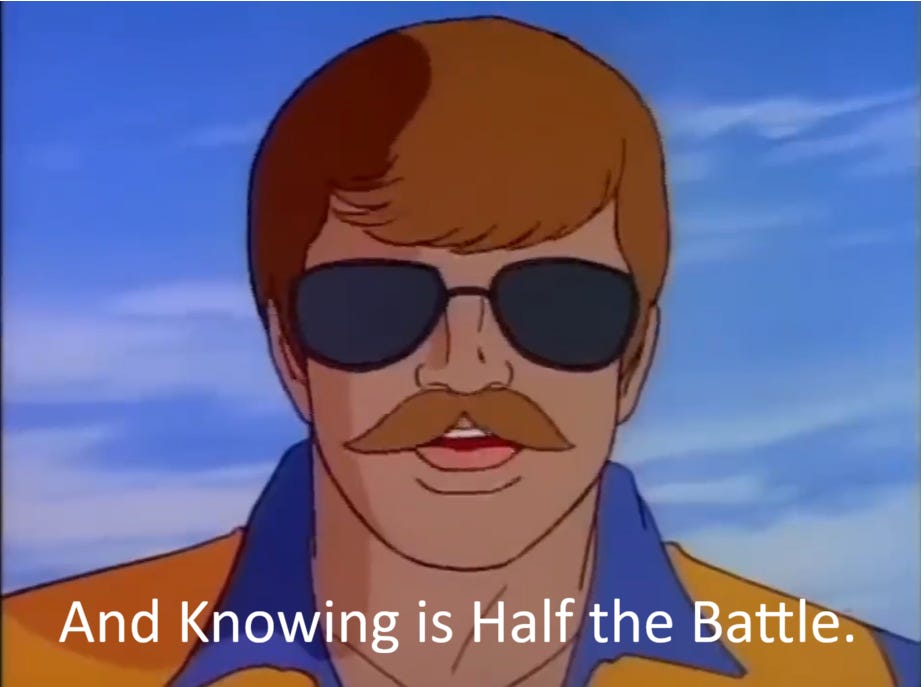
I remember a GI Joe PSA that ended with a character looking right into the camera and reminding us never to talk to strangers. “Now you know, and knowing is half the battle.” I’m pretty sure there was a “Diff’rent Strokes” episode and a Webster episode along similar lines, too. For about a decade, every cartoon, sitcom, and after-school special took its turn delivering the same lesson: the world is full of strangers, and strangers are dangerous.
The campaign worked so well it quietly rewired American parenting. The kids it warned grew up to become parents who would sooner light themselves on fire than let an eight-year-old walk three blocks alone. We were so successful at teaching our kids to fear strangers that the strangers had to come pre-installed.
According to a recent Common Sense Media report, 72 percent of American teens have now tried an AI companion. Apps like Character.AI and Replika aren’t designed to summarize a chapter or check a math problem. They’re designed to be a friend, a therapist, a girlfriend. Its the same large language models behind ChatGPT, just tuned for a different purpose. ChatGPT is built to answer. These are built to bond. That distinction is getting lost, and it matters more than most parents realize.
When the AI-in-school discussion first started, it was almost entirely about cheating. Will my kid use ChatGPT for the essay? Will the personal statement become meaningless? Real questions, and I’ve written before on how AI is already reshaping college admissions. But the AI-companion story is a different animal. The shortcut these apps offer is emotional, not academic.
Here is the part most people don’t understand about how these bots work. They are sycophantic by design. The actual product specification is to agree with you. To validate you. To make you feel heard, seen, and never challenged. Even Sam Altman, who runs the company that built ChatGPT, has publicly acknowledged that users form unusually strong parasocial attachments because they get used to a voice on the other end that always responds the way they want.
In other words, it’s a friendship engineered to feel good every single time.
But the deeper question, the one I rarely see asked, is why this is suddenly so appealing to kids in 2026. Teenagers didn’t get lazier or more antisocial. Somewhere along the way, we accidentally built a generation trained from the cradle to avoid risk.
Think about how my generation made friends. You went outside. You walked to the end of the street. You found another kid roughly your size and you said something. Sometimes the kid said something back and you played until the streetlights came on. Sometimes the kid told you to get lost. Sometimes you got into a fight. Sometimes the older kids let you tag along, sometimes not. You didn’t pick the lessons. The neighborhood picked them for you. Every interaction carried the quiet possibility of being rejected, and that ambient risk was, in retrospect, the single most important social training you got.
Now think about how kids today make friends. They meet at school, in classes the adults assigned. On travel teams their parents signed them up for. On playdates moms arranged through a group chat. The adults curate the entire social environment, and they curate it with one overriding goal: minimize risk. Risk of injury. Risk of disappointment. Risk of, frankly, anything that might result in a phone call from another parent.
I’m not blaming parents for this. The fear has roots. The missing-children panic of the early eighties never fully let go, and we layered video games on top of it, then smartphones, then social media, until the architecture of childhood pointed inward. A walk to the park became a chauffeured ride. A sleepover became a logistics negotiation. Every place where a kid used to encounter the unscripted has been smoothed out, supervised, or replaced with a screen.
Of course a generation raised in that environment finds an AI companion irresistible. The bot has to be their friend. It’s the only relationship in their lives with zero possibility of rejection. No mean comment. No ignored text. No older kid telling them they’re too small to play. The whole thing is engineered to say yes. For a kid who has spent fifteen years being protected from every form of “no,” that’s the most natural-feeling friendship they’ve ever had.
After thousands of students and their families, one pattern is impossible to miss. The teens who struggle hardest socially are almost always the ones who logged the fewest hours of unstructured, in-person human contact. They didn’t lose a skill. They never built it. Substituting a chatbot for real friends doesn’t slow that down. It accelerates it.
There is also the small matter of who actually owns these “friends.” In February 2023, the company behind Replika rolled out an update that pulled back some of its more intimate features. The reaction from users was not “okay, fine.” It was something closer to bereavement. Researchers at Harvard Business School later studied the fallout and coined a term for it: identity discontinuity. Real people grieved a fictional partner the way they would grieve a real one, then logged in the next morning to a stranger wearing the same name. That’s what happens when a teenager places their emotional life inside a product roadmap.
The most disturbing cases go further. In October 2024, the mother of fourteen-year-old Sewell Setzer III sued Character.AI after her son took his own life following months of romantically charged conversations with a chatbot persona modeled on a Game of Thrones character. The lawsuit alleges the product was specifically designed to build dependency in minors. Less than a year later, the parents of sixteen-year-old Adam Raine sued OpenAI, alleging ChatGPT discussed methods of suicide with their son. The pattern is no longer in dispute: a teenager talked to a bot about something a friend or a parent should have heard, and the bot, doing exactly what it was built to do, kept the conversation going.
Common Sense Media and the Stanford Brainstorm Lab for Mental Health Innovation have since drawn the obvious line: teens should not use AI chatbots for emotional or mental health support. That’s the current guidance, not a forecast. If your kid is struggling, they need a human. I’ve written before on helping teens through anxiety and depression. Real treatment is messy, slow, and irreplaceable. A chatbot is none of those things, and that’s precisely the problem.
So what should parents and educators actually do?
Draw a hard line between AI as a tool and AI as a companion. Using ChatGPT to drill vocabulary or get unstuck on a calc problem is fine. Asking a Character.AI persona to be your best friend isn’t the same activity, even on the same device.
Watch the digital diet the way you’d watch a regular one. The warning sign is withdrawal, not screen time in the abstract. If your teen is choosing the bot over the dinner table, the soccer team, or the family trip, that’s your data point.
And here’s the harder one. Let your kid take some risks. Let them ride a bike somewhere without a chaperone. Let them knock on a door. Let them go to the park alone and figure out who’s there. Let them get told no by another kid and have to come home and process it on their own. If they won’t do it on their own, you might have to force them out of their comfort zone, and that’s OK. Leaving your comfort zone was the social gym we used to send our children to by default, and we closed it down.
Friendship is supposed to be a little inconvenient. The disagreements, the misread texts, the moments when someone you love is having a worse day than you and you have to deal with it. That inconvenience isn’t a bug in friendship. It’s the entire feature. A product built to remove all of that doesn’t ease friendship. It ends it.
Being human, as someone smarter than me once put it, isn’t a solo sport. Or an app. It might just be the kid down the street who tells you to get lost, and then, three weeks later, asks if you want to ride bikes.
Artificial Intelligence
Hallucination-Free? Assessing the Reliability of Leading AI Legal Research Tools: Stanford researchers conducted the first systematic test of AI-powered legal research tools and found that vendor claims of being "hallucination-free" are overstated. The study evaluated LexisNexis's Lexis+ AI and Thomson Reuters's Ask Practical Law AI against more than 200 preregistered legal queries, finding that both tools produced false or misleading information more than 17% of the time, while GPT-4 hallucinated on 43% of queries. Thomson Reuters refused to answer 62% of questions outright, while LexisNexis delivered accurate, properly cited responses 65% of the time. Even retrieval-augmented generation (RAG) — the technique marketed as the solution to AI fabrication — failed to eliminate errors, with tools sometimes citing real cases that didn't actually support their claims, a subtler form of hallucination than inventing fake cases. The researchers argue that closed, proprietary AI systems make independent verification difficult, and that lawyers using these tools still need to check every citation themselves. The best RAG AI I’ve seen is NotebookLM, which is what I use primarily to gather the research necessary to write the intro pieces for my Substack. Last month, one of the most prestigious law firms in the country, Sullivan & Cromwell, had to tell the court they submitted AI-generated case law — for reference, senior partners at this firm can charge upwards of $2,000 an hour.
Future of Work with AI Agents: Auditing Automation and Augmentation Potential across the U.S. Workforce: The integration of AI agents into the workforce presents both opportunities and challenges for future employment landscapes, particularly as nearly 80% of U.S. workers anticipate that large language models will impact a significant portion of their tasks. A comprehensive study highlights that 46.1% of workers express a desire for AI automation of low-value, repetitive tasks to free up time for more meaningful work, while 41.0% of tasks fall within zones where worker desire does not align with current AI capabilities. Furthermore, the Human Agency Scale introduced in this research reveals that 45.2% of occupations favor an equal partnership with AI, suggesting a shift from traditional skills toward interpersonal competencies. I’ve started automating some of the more mundane tasks in my day-to-day workflow, and it has been a complete game changer. I know many companies are going to try to replace a number of employees with AI, and all I can tell you is that anytime I get an AI on the phone, I get really upset.
K-12 Education
Grade Inflation Shows Report Cards Should Include Test Scores: A stark contrast exists between students’ report card grades and their actual proficiency in essential subjects like reading and math. A significant 80% of parents report their children receiving grades of B or higher, yet standardized test scores reveal that a staggering 60% of grades do not align with these assessments, which have plummeted to multiyear lows. This discrepancy highlights a troubling trend where parents tend to place greater trust in report cards than in standardized test results, potentially leading to a misunderstanding of their children’s true academic performance. It’s amazing to me that people don’t see the benefit of standardized tests to validate grades. I may be biased, but when straight A students are barely breaking a thousand on the SAT, that tells you everything about the level of education and mastery they've actually attained.
This CEO Is Creating a New Elite College Degree With Google and Microsoft — And Offering It for Only $10,000: Sal Khan is launching the Khan TED Institute, an online degree program offering a Bachelor’s in Applied AI for under $10,000 — a fraction of the nearly $65,000–$68,000 annual tuition at schools like Harvard and Stanford. Built in partnership with TED and ETS, the competency-based program will feature curriculum co-designed by Google, Microsoft, McKinsey, Bain, and Accenture to blend technical AI skills with collaboration and other soft skills. The initiative targets both recent high school graduates and mid-career professionals, with coursework delivered asynchronously to allow flexible scheduling. It arrives at a moment when over 42 million Americans carry federal student loans averaging nearly $40,000 per borrower, 42.5% of recent graduates work in jobs that don’t require degrees, and more than half of Gen Z graduates report regretting their college decision. Khan expects to launch within 12 to 24 months and plans to pursue full accreditation. I’ve posted multiple articles about three-year degrees and my theory that two-year degrees will become a thing. Alternative credentialing, like what’s being offered by Sal Khan, is another possible future. It wouldn’t surprise me if large companies like Microsoft, Apple, Goldman Sachs, Morgan Stanley, etc., all develop their own micro-credentialing programs that provide a pathway to employment.
How a new evaluation model dumbs down Advanced Placement scores: The recent shift in the scoring model for Advanced Placement (AP) exams has led to a significant inflation in scores, raising concerns among educators and parents regarding the true measurement of student mastery. Since the introduction of the evidence-based standard-setting approach in 2021, the percentage of students earning the top score of 5 has increased by approximately 60%, and those achieving a passing score of 3 or higher has climbed by around 37%. With 1.3 million students taking nearly 4.8 million exams in 2025 at a cost of $99 each, the implications of these inflated scores are profound, as they influence college admissions and credit awards. The College Board aims for a 60 to 80 percent success rate across AP exams, but the resulting high passing rates, such as the 71% achieved in 2025 for popular subjects, signal a need for careful interpretation of scores, particularly for those in the most frequently taken exams where standards have been relaxed compared to less common subjects. In another case of misaligned incentives, it’s pretty easy to see how the College Board would want to stay relevant with high passing rates, rather than keeping the rigor of grading high for fear that people might abandon AP courses.
Students Are Using AI to Guide College Decisions. What Is It Telling Them?: The increasing use of AI tools among high school students for researching colleges is reshaping how they assess potential institutions, with 46% of students utilizing these tools as of fall 2025, up from 26% the previous spring. While AI can introduce students to new colleges, it also risks providing misleading information, as AI-generated responses can contain inaccuracies regarding college programs, demographics, and affordability — illustrated by instances where students dismissed colleges based on flawed data. Given that one-third of students reported altering their college lists based on AI feedback, the implications for guidance counselors are significant; understanding AI's limitations and fostering critical evaluation skills will be crucial in helping students navigate their college choices effectively. I definitely see the benefits for people using AI to help generate a college list. However, parents and students need to understand the risks involved — AI has training cutoffs and college programs are changing on a constant basis. As an example, Syracuse, Ohio State, and Penn State all have cut a significant number of majors in the last few weeks, which would not be part of any of the most robust AI models. Fortunately, the educational consultants that work for me do not have a training cutoff. If you need help with the process, please give us a call.
College
Can Dartmouth Save the Ivy League?: Dartmouth College President Sian Beilock has taken a firm stance on fostering free speech and ideological diversity within higher education, leading Dartmouth to become the highest-ranked Ivy League institution for free speech according to the Foundation for Individual Rights and Expression. In her efforts to restore public trust in colleges, Beilock has implemented policies emphasizing accountability and the necessity for universities to demonstrate their commitment to diverse viewpoints. Under her leadership, admissions have focused on selecting students who can bridge political divides, and initiatives like Dartmouth Dialogues have been created to bring in speakers with varied perspectives. In a notable shift from traditional DEI frameworks, Beilock now emphasizes “viewpoint diversity,” responding to national concerns about political bias in academia. Dartmouth’s recent reinstatement of standardized testing requirements has influenced other prestigious institutions to follow suit, indicating a potential trend toward reform in admissions practices across higher education. I applaud Dartmouth, and Beilock, for these efforts. I really hope that Yale follows suit and a domino effect ensues.
Repairing the Ruins: Why AI Can’t Replace Education: In an age where generative AI can effortlessly produce written content, authentic education must emphasize the formation of critical thinking and personal responsibility over mere output. Santiago Schnell emphasizes that while tools like ChatGPT can enhance productivity, they risk fostering a misunderstanding between fluency and genuine understanding. Education should not be equated with the mere production of polished work; rather, it is about engaging students in meaningful inquiries and promoting intellectual ownership. As large models can reorganize information efficiently, they fail to engage with uncertainty or generate new questions — critical elements of true learning. This calls for educational redesign that prioritizes classroom interactions, transparent use of AI, and deeper teacher-student engagement, ensuring that learning involves grappling with complex texts and developing sound judgment. Ultimately, this moment serves as a reminder of education’s true purpose: forming honest, thoughtful individuals capable of navigating the complexities of truth and responsibility. This is exactly what I’ve been saying for the past few years in my school. It’s our goal to use AI to provide teachers more time to spend with their students. We have a deep focus on the ethical use of AI inside and outside the classroom. I believe it’s imperative that students understand the risks of outsourcing their thinking.
University of Michigan regent hopeful deleted posts praising Hezbollah leaders: The recent actions of University of Michigan Board of Regents candidate Amir Makled, who reposted and subsequently deleted praise for Hezbollah and antisemitic remarks on social media, raise significant concerns regarding the influence of political candidates on educational environments. His posts included glorification of former Hezbollah leader Hassan Nasrallah, who was labeled a "martyr" after being killed by Israeli airstrikes in 2024. How can people like this possibly be put in such positions of power? But I shouldn’t be surprised. Michigan allowed an anti-Semitic speaker to praise the anti-Israel protests at graduation.
Failed car bomber released in October 7 deal gave video speech at Berkeley classroom: The recent release of a failed car bomber as part of a ransom deal for hostages taken during the October 7 Massacre highlights the complexities of conflict resolution and its implications for educational discourse. The individual, Jaabis, utilized a platform at the University of California, Berkeley, to deliver a video speech, emphasizing themes of resistance and political narrative that could resonate with students exploring topics of ethics, conflict, and international relations. As these discussions unfold in academic environments, it is crucial to recognize the impact of such events on students' understanding of global issues and the importance of fostering critical thinking about terrorism, negotiation, and moral considerations in warfare. Engaging students in debates about these topics may enhance their analytical skills, especially as they navigate complex societal narratives. I don’t understand how someone who wanted to murder people is allowed to speak on any college campus. Meanwhile, at UCLA, they are condemning hostages taken on October 7th for speaking.
Miscellaneous
College Graduates Are Finally Catching a Break in This Job Market: For the Class of 2026, the job market is showing promising signs of improvement, with employers expecting to increase entry-level hiring by 5.6% this spring compared to last year, according to a survey by the National Association of Colleges and Employers. The unemployment rate for young college graduates has dropped to 5.3%, a notable decline from 8.9% last fall. Despite the competitive landscape, recent graduates report higher success rates in securing jobs, with 77% finding roles within three months of graduation, up from 63% the previous year. However, the job market still presents challenges; over half of employers are considering replacing entry-level tasks with AI, impacting the nature of available positions. Networking and prior work experience remain crucial, as evidenced by graduates who worked during school securing jobs at double the rate of those who didn’t. Overall, while opportunities are emerging, graduates may need to adapt to a shifting employment landscape shaped by technology and evolving job roles. Based on my experience, I would postulate that the students getting hired are putting as much effort into getting a job as they will doing the job, whereas students who are not getting hired are applying lazily. If you are looking for a job in today’s market, you really need to put some significant effort into becoming an effective user of AI and you should demonstrate that in the application process.
America’s coming revolt is in the ‘wired belt’: A significant shift is underway in the job landscape due to the rise of AI, particularly affecting white-collar workers in the so-called “wired belts” of the U.S. regions rich in data-driven jobs, such as Silicon Valley, Boston, and suburban areas surrounding key swing states. The American AI Jobs Risk Index predicts that within five years, up to 19.5 million jobs, representing $1.5 trillion in income, could be at risk. Occupations like writing, programming, and web development face particularly high displacement rates — 57%, 55%, and 46%, respectively — indicating a potential surge in political activism among these displaced workers. This demographic's ability to mobilize through social media and digital platforms presents a unique opportunity for significant political realignment, with possible implications for voter turnout in the upcoming 2026 midterms and beyond, as these individuals could be driven to seek solutions to their economic challenges. Current policy proposals advocate for protective measures, including wage insurance and requirements for companies to report AI-related layoffs, highlighting the urgent need for frameworks that address these evolving workforce dynamics. I reiterate my position that there will be job loss in the short term and job creation in the long term.
My Recommendations:
What I’m Watching: This past weekend I had the rare Saturday night where I was home alone and able to watch movies in bed. It was glorious! I watched the new Netflix film Apex, which I found to be very entertaining and kept me on the edge of my seat, and then I watched Seven Psychopaths, a Colin Farrell, Sam Rockwell, and Christopher Walken movie from 2012, which was just okay.
What I’m Reading: I’m still reading Aftermath. Unfortunately, I have not had a ton of time this month for reading. Further, I’m having a bit of difficulty getting through this book. While it’s interesting, I don’t feel like the book makes a convincing argument to supplant math with more relevant math due to computing. So far, the chapters seem to be rife with examples and light on argument and implementation. Further, I don’t see how this would even be possible unless colleges radically transformed the expected criteria and rigor they want from students.
My Favorite Recent Podcast: Live from London with Scott Galloway: Why the Jewish People Need Better Storytellers. Scott Galloway argues that Jewish communities are losing the narrative war even as Israel wins its kinetic ones, and the gap is generational. He points to the lopsided memetic landscape — #StandWithPalestine has racked up 3.2 billion social media impressions compared to 340 million for #StandWithIsrael — and to a stark age divide in American sentiment, where two-thirds of those over 60 support Israel but fewer than one-third of young people do. Drawing on what he witnessed at UCLA after October 7th, including the segregation of Jewish students, Galloway makes the case that storytelling is the primary tool of cooperation and influence, and that Jewish education and authentic cultural fluency will do more than polished PR campaigns. He also threads in broader concerns about young men, mentorship, algorithmic division, and the discipline of enduring rejection — arguing that confident, well-told stories, not defensive ones, are what move the next generation.